

From Outsourcing to the Global Supply Chain
There are young Vietnamese entrepreneurs who refuse to accept the fate of being merely “outsourcing manufacturers.” Through intelligence and relentless effort, they have become key suppliers for world-famous multinational corporations.
Taking on the “Impossible Orders”
The journey of Mr. Nguyễn Trọng Đáng, Director of Việt Nguyên Precision Mechanical Co., into the semiconductor and aerospace industries began when he joined an American company. After working there for five years, he started his own business in 2011, founding Duy Việt Company — a name symbolizing “Vietnamese mindset.”
“In the early 2010s, the semiconductor industry in Vietnam was still very new, and most companies only produced molds. In 2013, we received a game-changing order to manufacture components for chip testing machines used in Apple’s iPhone products,” Mr. Đáng recalled.
“At that time, we could not obtain bank loans because we had no collateral assets. Orders were coming in rapidly, but fortunately, our partner advanced payments and allowed delayed material payments.”
The company’s revenue was only around VND 3 billion in 2016, but by 2020 it had reached VND 20 billion annually. The company was later renamed Việt Nguyên, meaning “Vietnam’s new era.” By 2025, revenue had grown to hundreds of billions of Vietnamese dong, and the factory expanded from just 200 square meters to 6,000 square meters.
According to Mr. Đáng, the journey was extremely difficult. He started with only VND 160 million, enough to buy a single machine for small repair jobs involving defective products. Whenever the company accumulated some profit, it reinvested in machinery to handle more challenging orders — the “hard jobs.”
One example was components used in iPhone chip-testing machines. Some modules measured only a few millimeters but contained up to 14 tiny parts. If just one detail was defective, the entire product had to be discarded.
Mr. Đáng also shared that a German partner once ordered a shaft coupling component — a part used in iPhone product-testing systems — priced at 39 euros. Yet even then, defective items were still sent back to Việt Nguyên for repair.
On another occasion, a partner casually asked, “Can you do this?” He immediately answered, “Yes, we can,” even though he had no clear idea yet how it would be done. After receiving the drawings, his team researched, developed prototypes, and remarkably passed customer approval on the very first attempt — at only half the original price.
That success led to contracts worth tens of millions of dollars and opened the door to increasingly complex components.
Today, Việt Nguyên can manufacture up to 60% of the components used in iPhone chip-testing machines, getting closer to the semiconductor core technology itself. The company has also entered the aerospace sector, becoming a supplier of cabinet components for companies such as Safran and Boeing.
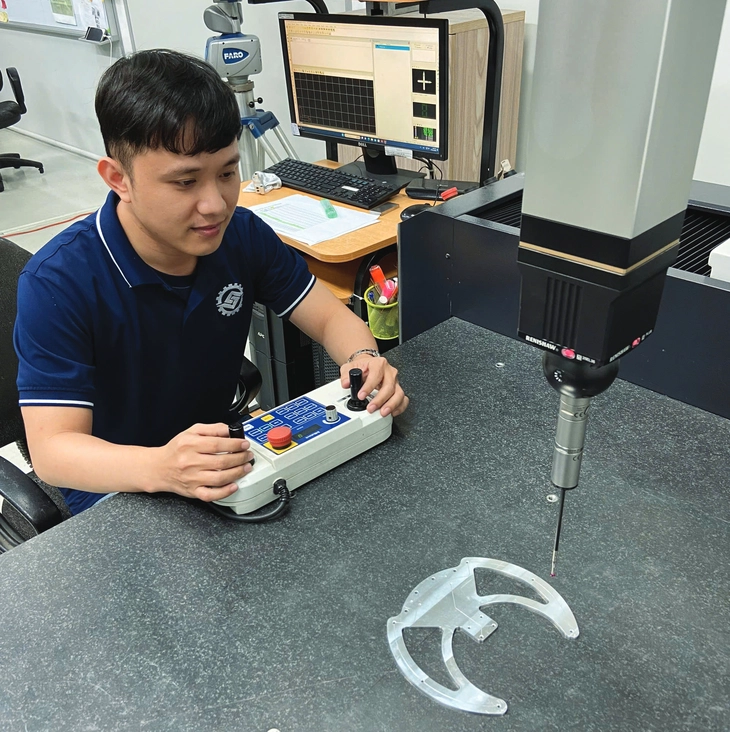
Finished cabinet components are manufactured and supplied to Boeing - Photo: P.S
Mastering Automation Technology
While introducing a 2,700-square-meter production line in Linh Xuân Ward, Ho Chi Minh City, Mr. Đỗ Hoàng Trung — founder, Chairman, and CEO of IDEA Group — acknowledged that many people still assume Vietnamese companies mainly perform outsourcing work.
However, IDEA Group operates highly automated manufacturing lines and also develops robots, autonomous vehicles, and other advanced products entirely researched, designed, and manufactured by Vietnamese engineers. These products are exported to Japan, the United States, Canada, India, Australia, and other markets.
Mr. Trung’s passion for automation began nearly 20 years ago while studying mechanical engineering in Japan. He first started as a design service provider, but after five years in business, he pursued his dream of manufacturing automated production systems for FDI enterprises in Vietnam and export markets.
According to him, the journey required continuous improvement, process standardization, and strong investment in human resources. Vietnamese companies also face fierce competition from low-cost Chinese products.
IDEA’s strategy therefore focuses on the premium segment, using advanced machinery built to G7 standards. The company reduces costs to offer competitive pricing while maintaining on-time delivery and professional after-sales support.
During the COVID-19 pandemic, a Japanese electric motor manufacturer could not bring experts into Vietnam to repair equipment, so it asked IDEA for assistance. The customer needed a fully automated inspection system with high speed, high precision, and full data traceability.
IDEA’s engineering team concentrated all efforts on research and delivered multiple technical solutions. As a result:
- inspection time was reduced from 5 minutes per motor to 2 minutes,
- defect detection accuracy improved by 30%,
- and 100% of inspection data could be stored and retrieved.
Mr. Trung stated that the company spends up to 30% of its annual costs on research and development (R&D) to create genuine “Make in Vietnam” products.
To date, IDEA has implemented numerous projects, including:
- automated motor assembly lines using 6-axis robots,
- automatic inspection systems operating at 4 seconds per product,
- 3D printing solutions integrated with robotic arms,
- AMR autonomous mobile robots for electronics factories,
- and automated pallet transport systems replacing manual forklifts.
With Vietnam’s new policies supporting science, technology, innovation, and private-sector development, Mr. Trung hopes industries such as robotics will receive stronger support and priority for Vietnamese-made products, enabling Vietnamese businesses and technology to compete globally.
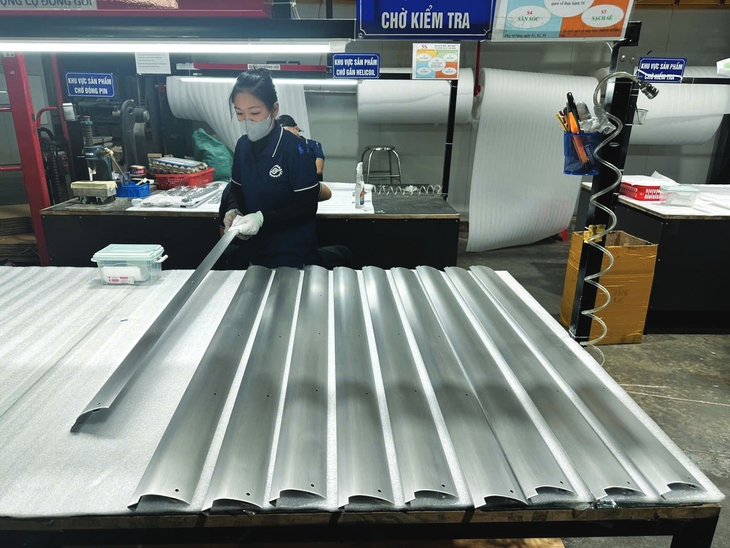
Finished cabinet components are manufactured and supplied to Boeing - Photo: P.S
Growing Strong Through Magnet Wire Manufacturing
For Mr. Nguyễn Ngọc Thịnh, Director of Tiến Thịnh Manufacturing, Service, and Trading Co. in Ho Chi Minh City, taking over the family business in 2005 marked the beginning of a transformation.
Originally a traditional industrial manufacturer specializing in magnet wire, the company successfully joined the supply chains of multinational corporations operating in Vietnam, including Toyota, Honda, Toshiba, Brother, and GE.
But Mr. Thịnh wanted more.
More than five years ago, when he learned that TTI — one of the world’s leading power tool suppliers — was relocating factories to Vietnam, he aimed to become one of its partners and enter a global market worth approximately USD 50 billion.
“It can take anywhere from two to five years, sometimes even ten years, to join a global supply chain,” he explained.
When approaching TTI, the company required international certifications such as ROHS, REACH, and IATF.
Magnet wire components used in high-performance power tools directly affect user safety and therefore must meet extremely strict and consistent quality standards. Tiến Thịnh invested heavily in raw materials, testing, optimization, and learning from Japanese, German, and American manufacturing practices.
“We spent six years on this journey. Entering the global supply chain is a major challenge. But now we are finally seeing results through orders from TTI, which will serve as a foundation for even greater opportunities ahead,” Mr. Thịnh said.